- #meta-ads
- #growth
- #playbook
How we restructure a Meta ad account in 2026 (and why it usually halves CPL)
The exact account restructure we run when we inherit a tangled Meta ads account in 2026 — fewer campaigns, cleaner signals, faster creative tests.
Most ad accounts we inherit in 2026 share the same problem: too many campaigns, fragmented signal, and a creative cadence that never gets to statistical significance. We've shipped this restructure across more than a dozen accounts, and the pattern is now boring in a good way — fewer campaigns, cleaner signals, faster creative tests.
This is the playbook.
1. Audit before you touch anything
Before we delete a single ad set, we capture three weeks of baseline:
- Spend, CPL, ROAS by campaign and by buying type
- Pixel + CAPI dedup rate (we look for >80% on key events)
- Creative inventory — how many distinct hooks, formats, and angles are live
If the dedup rate is below 80%, the account is flying blind. We fix tracking first, before we touch structure. Otherwise we're going to credit the restructure for gains that are really just Meta seeing the data properly.
2. Consolidate to three campaigns
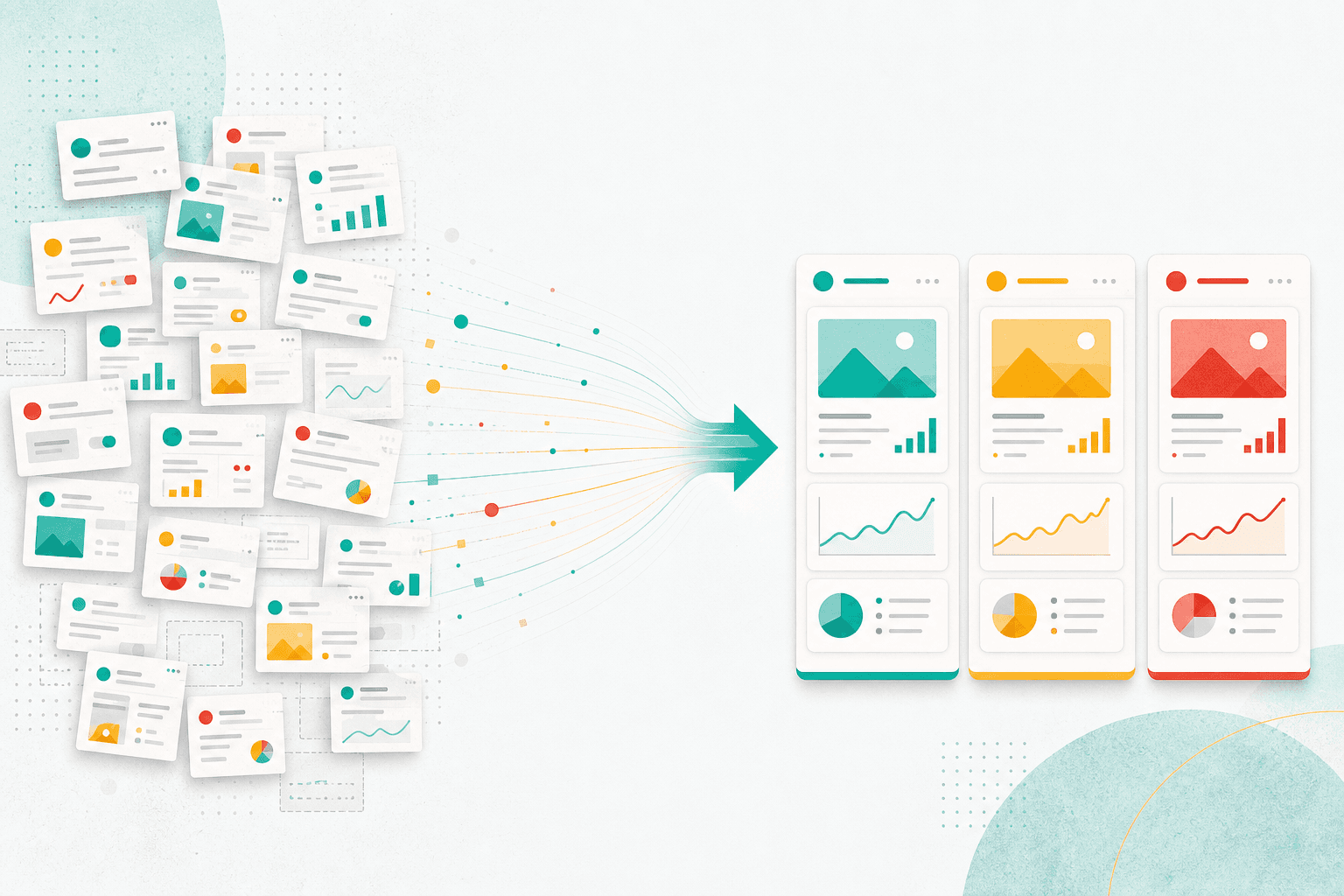
Most accounts we inherit have 12+ campaigns running. By the time we're done, almost every account fits into three:
- Prospecting (Advantage+) — broad audience, creative-led learning.
- Retargeting — last 30/60/90 days site + IG/FB engagement, capped budget.
- Brand / always-on — light spend on the highest-trust creatives.
That's it. Anything else has to earn its way back in.
The single biggest unlock isn't the structure — it's that consolidation gives Meta enough conversions per ad set per week to actually optimise.
3. Fix the events
Conversions API + dedup is non-negotiable in 2026. We:
- Move all server-side events to CAPI with proper
event_iddeduplication - Standardise on a small event vocabulary (
Lead,Purchase,InitiateCheckout) - Pass hashed
em+ph+client_ip_address+client_user_agent - Use a server-side
Leadafter every form submit, fired with the sameevent_idas the browser PixelLead
Done right, the dedup rate climbs above 90% within a week and Meta's models stop guessing.
4. Run creative like an R&D lab
The single biggest change vs. 2022-era Meta is that creative volume is the bid. Targeting matters less than ever; what you're saying matters more.
Our weekly cadence:
- 6 new creative concepts per week (3 hook variants × 2 formats)
- 1 batch goes live Monday; we kill underperformers Thursday
- Winners get re-cut into 3 new variants the following week
- Losers get autopsied — was the hook off, or the delivery?
A single ad set inside the prospecting campaign holds 12-15 active creatives at a time.
5. Report on what matters
We never put cost-per-click on a dashboard. The board cares about CPL, CPQL (cost per qualified lead), and contribution margin. Everything else is operations.
Our default Looker Studio view:
- CPL by week + by creative concept
- Qualified-lead rate (from CRM, joined back via offline conversion import)
- Spend split: prospecting vs retargeting vs brand
- Creative leaderboard — top 10 hooks by CPQL
What you should do this week
- Pull a creative inventory of your last 90 days. Count distinct hooks.
- Audit your Pixel + CAPI dedup rate.
- If you have more than 5 active campaigns, list which ones earned their slot.
If any of that sounds painful, book a free audit or WhatsApp us — we're happy to walk through your account.
Ship this on your account
Want us to run this playbook on your project?
Send a two-line brief. A senior strategist reviews personally and comes back within one working day with next steps, a realistic plan and a written proposal in 48 hours.